Migrating this blog from Hugo to Astro
This blog has been built with Hugo since 2021. Over the years I created my own theme, updated the CI pipeline, and eventually open-sourced the repo. Hugo served me well but I had been wanting to move to something where I had more control over the components and layout without maintaining a separate theme repository as a git submodule. I decided to migrate to Astro.
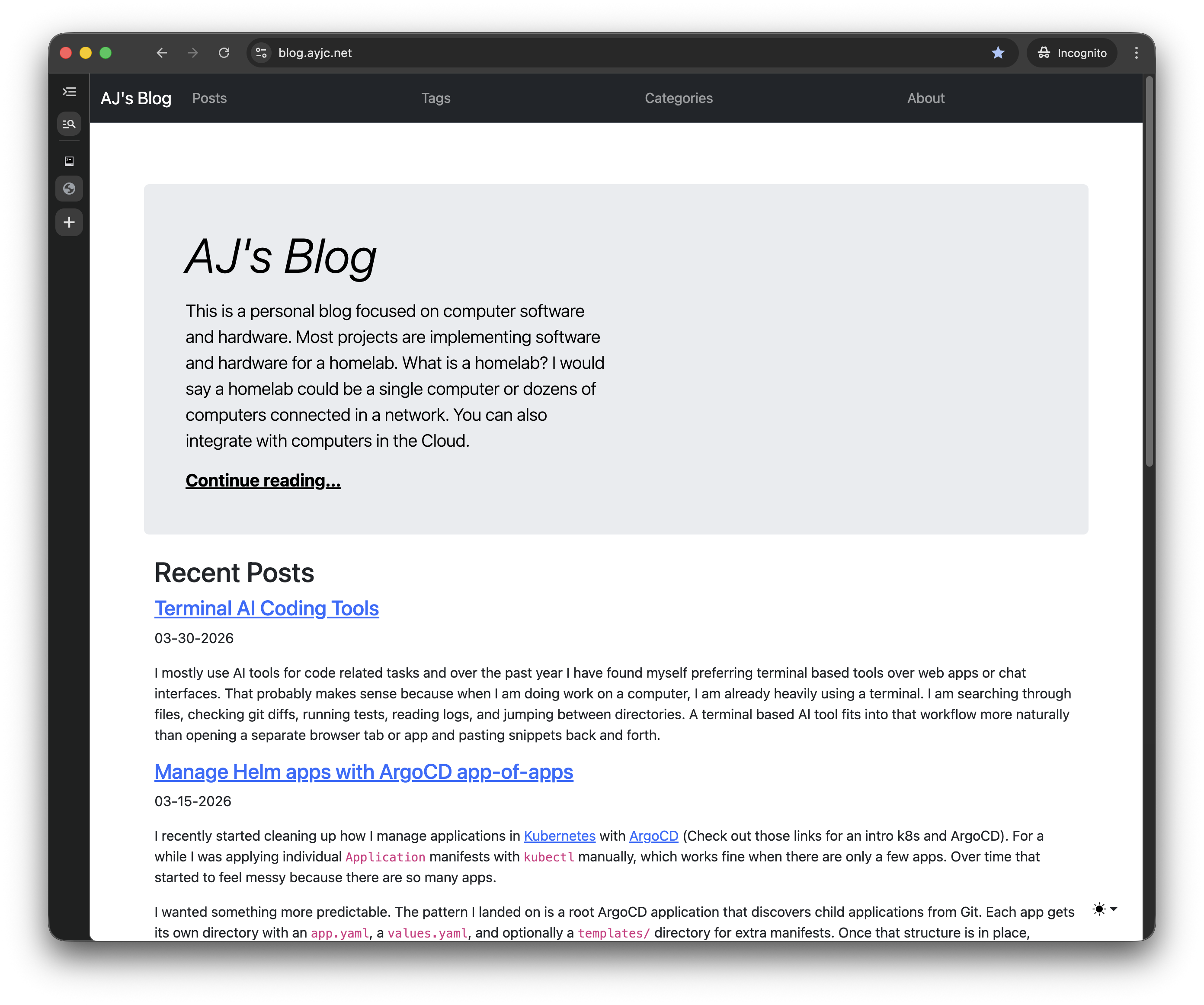
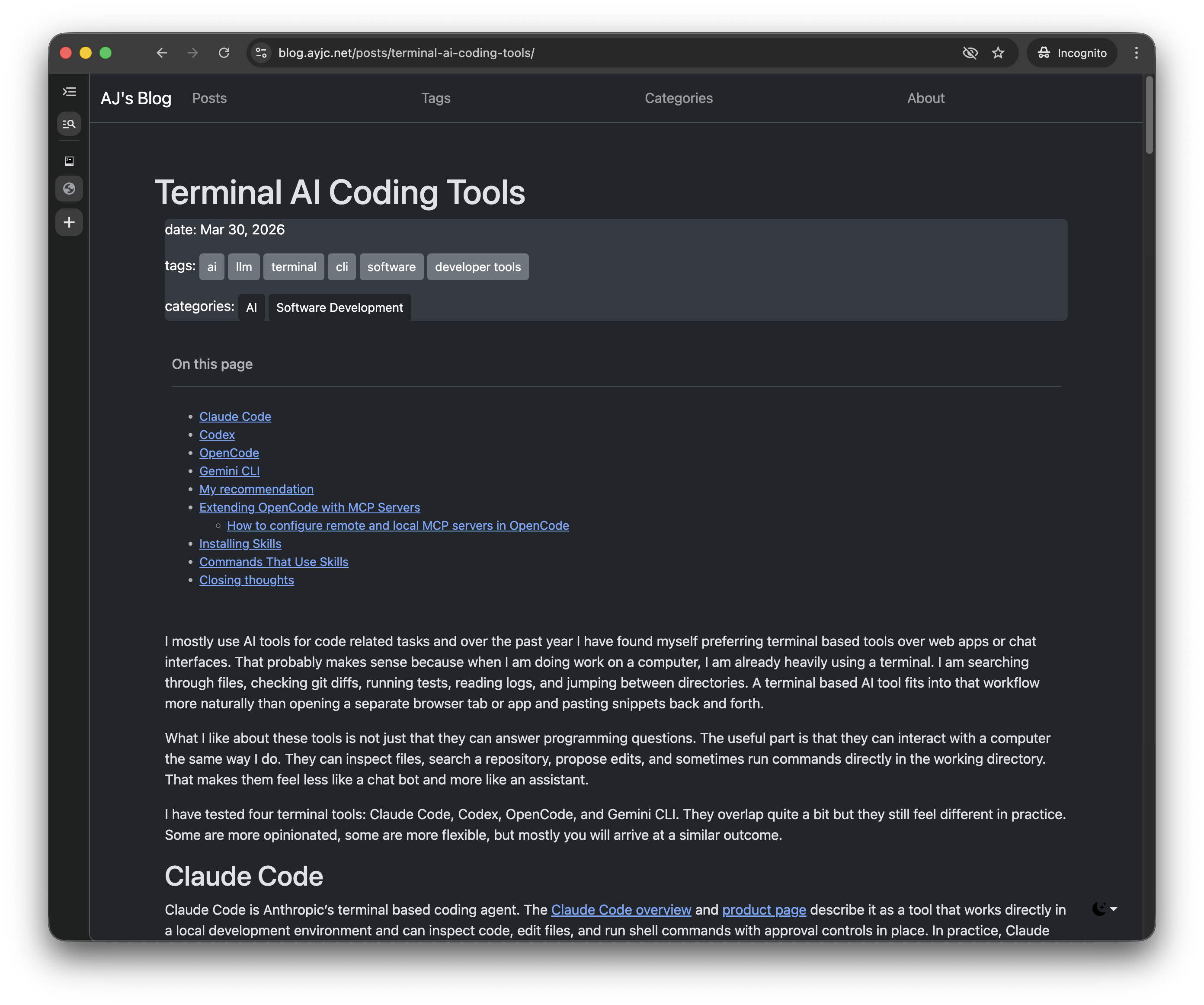
Before
The Hugo site with the Bootstrap-based ajsTheme:
Light theme:
Dark theme (on a post):
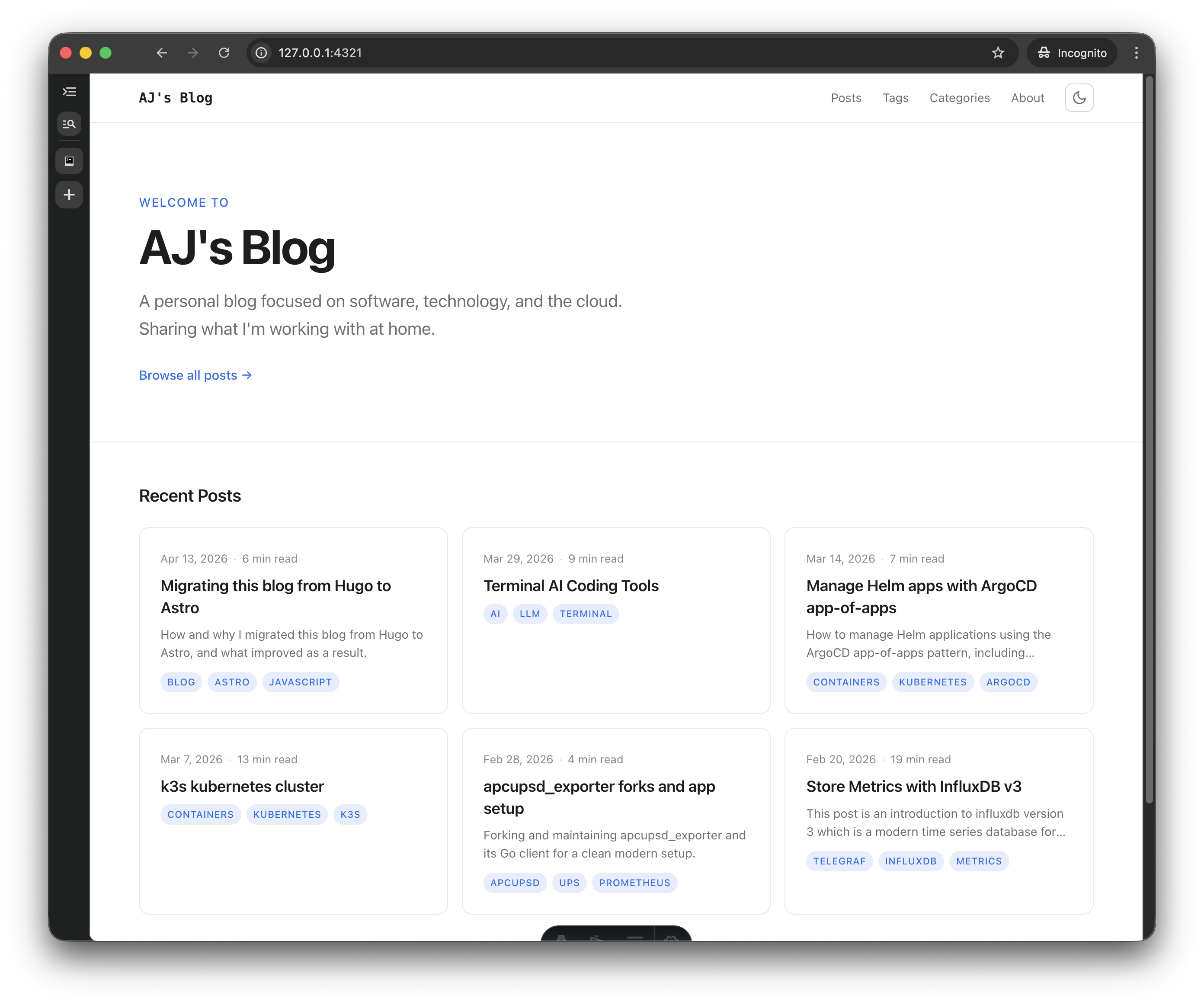
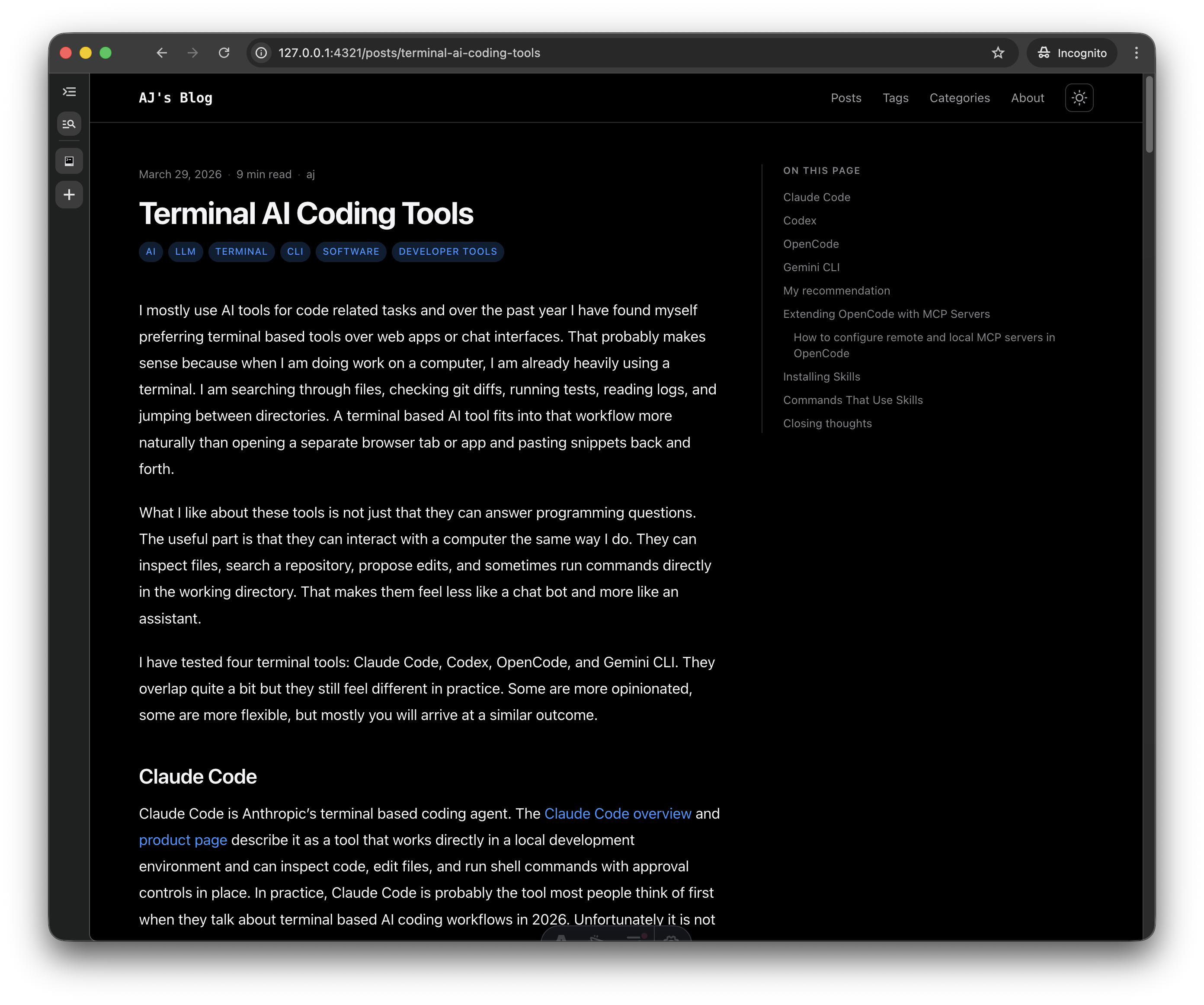
After
The new Astro site:
Dark theme:
Why Astro
A few things pushed me toward Astro:
- No more git submodule theme. My Hugo theme was a separate repo that I had to keep in sync. With Astro, layouts and components live directly in the project under
src/. - Component-based architecture. Astro uses
.astrocomponents that combine markup, scoped CSS, and logic in a single file. This is easier to reason about than Hugo’s template inheritance and partial system. - No framework dependency. My Hugo theme pulled in Bootstrap CSS and JS (~318 KB per page load). Astro components use scoped CSS with custom properties. The site now ships zero client-side JavaScript and ~11 KB of CSS.
- Better developer experience. Astro runs on Node.js with hot module replacement via Vite. The feedback loop is faster than Hugo’s live reload, and I can use the npm toolchain.
- Content Collections with type safety. Astro validates frontmatter against a Zod schema at build time. I caught several frontmatter issues during the migration that Hugo silently ignored.
What the migration involved
Content
All 153 markdown posts moved from content/posts/ to src/content/blog/. The frontmatter was almost entirely compatible. title, date, tags, categories, image, draft, and author all carried over without changes. I only had to fix three posts:
- One post had an empty YAML list item in
categoriesthat Zod caught during build - Two posts used a capitalized
Titlekey instead of lowercasetitle
Hugo would silently accept all of these. Astro’s schema validation caught the issues.
Code blocks
Hugo uses Chroma for syntax highlighting. Astro uses Shiki which supports dual themes. I now have github-light and github-dark themes that switch automatically with the site’s dark mode. About 30 posts had fenced code blocks with language identifiers that Shiki did not recognize (like conf or Docker). I updated those to the correct identifiers (nginx, dockerfile, etc.).
Images
Static images moved from static/images/ to public/images/. Since all my posts reference images with absolute paths like /images/example.png, no content changes were needed. The repo uses git LFS for images, and because LFS is content-addressed, moving the files did not duplicate storage.
Project structure
The new structure looks like this:
src/
  content/blog/        # 153 markdown posts
  components/          # PostCard, Pagination, ThemeToggle, etc.
  layouts/             # BaseLayout, PostLayout
  pages/               # all routes
  styles/
    global.css         # CSS custom properties, light/dark theme, reset
    patterns.css       # shared UI patterns (post-grid, chips, cards)
  utils/               # reading time helper
public/
  images/              # post images (git LFS)
  robots.txt
CSS is split into two layers: global.css for tokens, reset, and base typography, and patterns.css for reusable UI patterns like the post grid, tag pills, and surface cards. Page-specific styles stay scoped in each .astro file. This avoids the pattern duplication that creeps in when every page re-declares the same grid or pill styles.
New features
A few things I added during the migration:
- Pagination on the posts listing, tag pages, and category pages using Astro’s built-in
paginate()function - Featured images on post cards. Posts with an
imagefrontmatter field show a thumbnail on the card - Sitemap generated automatically by the
@astrojs/sitemappackage. - Custom 404 page
- Reading time estimates on every post
- Contact section on the about page, replacing the Disqus comment system that was part of the Hugo theme
CI pipeline
The GitLab CI pipeline gained a test stage with ESLint and Prettier checks that run before the Docker build. The Docker build itself switched from a Debian image that downloads the Hugo binary to a simple node:24-alpine multi-stage build:
FROM node:24-alpine AS build
WORKDIR /app
COPY package.json package-lock.json ./
RUN npm ci
COPY . .
RUN npm run build

FROM nginx:alpine
COPY --from=build /app/dist /usr/share/nginx/html
COPY nginx.conf /etc/nginx/conf.d/default.conf
EXPOSE 80
Once the site is generated, the content is hosted on an nginx web server. The nginx config needed a couple of tweaks for Astro’s output format: absolute_redirect off to keep redirects relative (so they work regardless of port), and a try_files order that checks $uri/index.html before $uri/ to avoid unnecessary 301 redirects on every page load.
Performance
The build is faster and the output is lighter:
| Metric | Hugo | Astro |
|---|---|---|
| Build time | 2.45s | ~1.04s |
| CSS + JS per page | 318 KB | 11 KB |
| Client-side JS | 85 KB | 0 KB |
| Framework dependency | Bootstrap 5.3 | None |
Since both versions produce static HTML served behind AWS CloudFront, the serving latency is the same. The browser downloads about 307 KB less per page load.
URL compatibility
One of my concerns was breaking existing links for search engines. Hugo’s permalink config was posts = "/posts/:contentbasename" which produces the same URLs as Astro’s file-based routing. Tag and category URLs are also unchanged. The only URLs that no longer exist are Hugo’s per-section RSS feeds (like /tags/docker/index.xml). The global RSS feed at /rss.xml still works.
I added a robots.txt and an auto-generated sitemap to help search engines discover the new structure. I also cleaned up trailing slashes from all internal markdown links — Hugo generated URLs with trailing slashes and many of my posts had carried that convention in their cross-references.
Performing the migration with AI tools
After hearing more about Astro I used Claude Code to plan and implement a migration to Astro using an example blog project I set up on GitLab all the way back when I first created my blog using Hugo. I have used this project over the years when I have made changes to the theme of my blog as a proving ground.
I used Claude Code with model Opus 4.6 to create a plan and then implement that plan. After several iterations the new site was ready and I created a pull request (known as merge request on GitLab) to review the migration changes. While I prefer to use OpenCode for this type of agentic coding, The Anthropic models are better at Frontend design and I want to use my Claude Pro subscription instead of paying for API tokens which does not work with OpenCode.
Code review with Codex
Once the PR was open I used OpenAI Codex with model GPT 5.4 to review the changes. This review caught a few issues with the new framework:
- Posts marked as drafts in front matter were still being fully rendered in the site.
- The site’s main URL was hard coded in the Astro config.
Closing thoughts
I have been wanting to do this for a while. In the 2024 theme post I mentioned wanting to eventually move away from the Bootstrap framework and this migration accomplishes that and more. The site is faster, the codebase is simpler, and I no longer need to maintain a separate theme repository. All the content and all the URLs carried over without changes.
The source code is available on GitLab and mirrored on GitHub.
Disclaimer: I used an LLM to assist with this migration and post. Opinions expressed are my own.