This week in the homelab- November 28, 2026
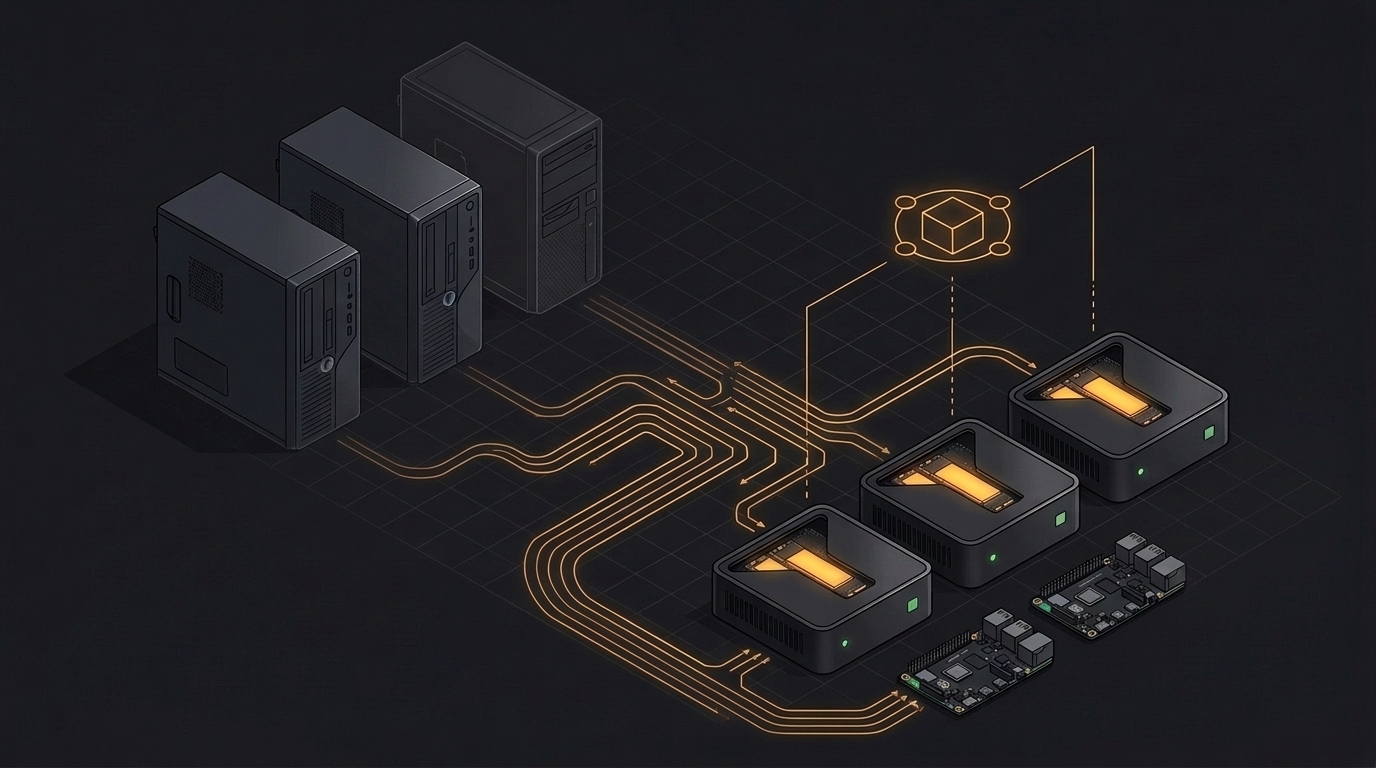
Last week was about local models and GPUs. This week turned into the biggest infrastructure overhaul I’ve done in a while: moving every node in my k3s cluster from Ubuntu 24.04 to Ubuntu 26.04.1, and then retiring all three of my aging HP Proxmox hosts (hp01, hp02, and hp03) onto three NVMe machines (beta, delta, and epsilon). In between cluster work, I also merged nine pull requests on Isle of Babel 2 and finished Meridian House’s adaptive render-scale menu.
Ubuntu 26.04 on every k3s node
All ten k3s nodes—three control-plane VMs, four worker VMs, two Raspberry Pi 5s, and my GPU workstation—are now on Ubuntu 26.04.1, rebuilt one node at a time while workloads moved around them. I tracked the migration as a milestone of 17 issues in my private Gitea: seven prep issues, nine for the nodes that needed rebuilding, and one for cleanup. Most of the actual changes landed in two days.
A virtual IP for the API
Every node used to reach the Kubernetes API through the first control plane, cp-01. That made one VM special, and rebuilding it would have taken the API address with it. So the first change was a virtual IP for the API, held by keepalived on all three control planes. If the API server on the node that holds the address stops answering its /livez health check, another control plane takes the address over. I tested that by shutting cp-01 down.
Every node now joins through that address, as does my workstation’s kubeconfig, and Cilium reaches the API through it too. The k3s settings moved out of command-line flags into /etc/rancher/k3s/config.yaml, which Ansible writes. That made rebuilding a node a matter of running a playbook.
Rebuild, don’t upgrade
I didn’t run do-release-upgrade on the VMs. Each Proxmox host got an Ubuntu 26.04 cloud-init template, and Terraform rebuilt each VM from it with terraform apply -replace. One node at a time:
- Drain the node and delete it from Kubernetes.
- Rebuild the VM from the new template.
- Rejoin it with Ansible. I always ran the playbook in check mode first and confirmed it would join through the virtual IP.
- Check that the node is Ready and that Cilium’s health checks reach every other node.
One gotcha came up before anything moved. With the Proxmox Terraform provider I use, changing a VM’s target_node doesn’t rebuild the VM on the new host. It plans a live migration of the running VM and its disk. I added target_node and clone to ignore_changes, so a plain terraform plan stays empty and a VM only moves when I ask for a -replace.
worker-02 went first as the canary and ran overnight before I touched anything else. The rest of the workers followed the next morning. For the control planes I copied an etcd snapshot off the node before each rebuild. Before the last one, cp-01, I moved etcd leadership to another member first.
The Raspberry Pis
The Pis were the plan’s weak spot. I started with an in-place upgrade on rho, and kured rebooted it halfway through. Draining a node doesn’t stop the kured DaemonSet, the upgrade had written /var/run/reboot-required, and kured did exactly what it’s built to do. rho didn’t come back. Now the runbook takes a manual kured lock before any OS work:
kubectl -n kube-system annotate ds kured \
  weave.works/kured-node-lock='{"nodeID":"manual"}' --overwrite
So both Pis got a fresh 26.04.1 install instead. The host-level setup now lives in an Ansible playbook: sysctls, apcupsd for each Pi’s own UPS, and the UPS exporter for Prometheus. I also took the chance to fix a typo I’d lived with since 2024. omnicron came back as omicron, on an NVMe drive instead of a ten-year-old microSD card.
The reflash had a few surprises:
- No network after boot.
rhobooted with its link lights on and no IPv4 address. The 26.04.1 Raspberry Pi image doesn’t enablesystemd-networkd, so after the initramfs hands off nothing applies the netplan config. I fixed it by mounting the card on my workstation and runningsystemctl --root=... enable systemd-networkd.service. My cloud-init template now enables it on first boot, and that worked onomicronwith no manual steps. - No passwordless sudo. Raspberry Pi Imager writes
sudo: nullfor the default user, so Ansible couldn’t escalate. I wrote my ownuser-datainstead of using Imager’s customization. - Flashing NVMe without an adapter. I had no USB enclosure for the NVMe drive. So I fitted the drive, booted the old SD card, wrote the image to
/dev/nvme0n1withddfrom the running Pi, and pulled the card. Both disks label their root partitionwritable, so the SD card has to come out before the next boot. - Unattended upgrades on first boot. A fresh image spends 25 to 40 minutes on about 130 package updates, including a new kernel. Ansible’s apt tasks now wait for the lock, and I reboot once before joining the cluster.
Smaller lessons
- A descheduler CronJob evicts pods from cordoned nodes every two minutes, so cordoning a node isn’t passive.
- CloudNativePG won’t scale a cluster down while one of its instances is Pending. I moved the three Postgres databases by temporarily running two instances and switching the primary over.
- Ubuntu 26.04 no longer reads
/etc/sysctl.conf. Custom settings belong in/etc/sysctl.d/. - My Prometheus config is bind-mounted into its container as a single file.
git pullreplaces the file, so the container keeps reading the old copy, and a reload doesn’t help. The container needs a restart. - The playbook that installs the Cilium CLI had been reinstalling it on every run. Its version check used an
--output jsonflag the current CLI doesn’t have.
Retiring all three HP Proxmox hosts
Two weeks ago I added beta, a small Ryzen mini PC with NVMe storage. During the 26.04 migration, k3s lost etcd leader election on all three control planes at once, and later on one of them while I rebuilt a worker on the same host—classic symptoms of slow fsyncs on the HP hosts’ shared consumer SATA SSDs. That convinced me not to stop at hp02. By Saturday afternoon, all three HP hosts were emptied and retired:
betareplacedhp02: took overcp-02andworker-02, plusblackhole(moved offhp03at 2.5 GB RAM).deltareplacedhp01: brought into Terraform and Ansible with its own Ubuntu 26.04 template, tookworker-01andcp-01via offlineqm migrate, tookvegafromhp03, and inheritedhp01’s UPS and KVM (kvm-delta).epsilonreplacedhp03: tookworker-03andcp-03, inheritedhp03’s Back-UPS XS 1000M and KVM (kvm-epsilon), and closed out the last HP node in the inventory.
Moving the hosts also forced a handful of long-overdue cleanups:
- Another AppArmor surprise on Ubuntu 26.04. Kernel
7.0.0-41(with the fix for CVE-2026-90231) force-stacks containerd’s AppArmor profile intocri-containerd.apparmor.d//&unconfined, which breaks intra-container signals under containerd 2.3.7. PostgreSQL 18 hung during theworker-01migration and Go processes lostSIGURG. I added a custom containerd AppArmor profile with stacked-peer rules to every k3s node until k3s ships the upstream containerd fix. - Standalone UPS monitoring on
kappa. I repurposed an old Raspberry Pi 3B askappa(Ubuntu 26.04.1, kept in its own inventory outside k3s) to monitorhp02’s Back-UPS ES 600M1. - Unified
apcupsd_exporterand Grafana Alloy. Every UPS host (rho,omicron,kappa,delta, andepsilon) now runs the same non-root, source-builtapcupsd_exportervia Ansible, and the Proxmox hosts pluskappanow get Grafana Alloy from an Ansible playbook instead of hand-copied notes. - Memory tuning. Raised all three k3s control planes from 4 GB to 6 GB RAM, and dropped
nas-backupongammafrom 64 GB to 32 GB (with ZFS ARC capped at 24 GiB) ahead of a physical DIMM swap.
Isle of Babel 2
Isle of Babel 2 had a busy week on GitHub with nine pull requests merged:
- Materials, ocean, and clouds: baked warm limestone ashlar and warmer shaded lighting for the tower exterior, guarded far-island distance LODs, added turquoise shallows with a visible volcanic shoreline from the summit, and switched the low cloud deck to raymarched volume.
- Terrace brazier: added a hand-modeled brazier prop with flame sheets over a charcoal bed and pulsing embers.
- Capture reliability: captures now fail loudly when Godot hangs on exit instead of stalling quietly.
- Two architecture decisions: ADR-0003 ran an engine decision test and confirmed staying on Godot; ADR-0004 adopted Blender Lab MCP so Claude can run live viewport checks during tower edits (while Codex stays script-only).
One PR is still open for a walkable exterior route up to the observatory roof.
Meridian House
I landed the adaptive graphics menu PR I mentioned last week: pressing Esc now opens a graphics settings menu with an adaptive render-resolution mode, so the RTX 5090 no longer gives up resolution to match the MacBook Pro’s 4.1-megapixel FSR 2 budget.
Also this week
- Published Running Qwen3.8 on Kubernetes with an RTX 4090, covering the switch from Gemma 4, context sizing, and the AppArmor bug that leaked 23 GB of VRAM.
- Started a private
agents-homerepo on GitHub to track my coding-agent setup: skills, MCP servers, owned settings, and a setup script. - Merged the macOS cask cleanup in linux_setup so
herdr-appandhomebrew-appare shared while Steam stays machine-local. - Cleaned up my
character_sheetsite: fixed a hidden paper texture, simplified the stylesheet, and added a desk d20.
Updates
Renovate merges this week:
- In the cluster: an Argo CD Helm chart bundle (
alloy1.16.0,cloudnative-pg0.29.2,external-secrets2.15.0,gpu-operatorv26.7.3,kube-prometheus-stack93.11.1,ollama1.96.0,open-webui18.5.0, andreflector10.0.81), plus SearXNG2026.11.21. - On
alpha: cAdvisor0.61.1.
Still open: AdGuard Home v1 on blackhole (still waiting on a release-notes review), along with Grafana 13.3.2, Argo CD 3.6.3, n8n 2.50.2, VersityGW 0.4.13, and Fluent Bit 5.2.1.
Next
Next week I plan to:
- Finish the physical DIMM swap on
gammanow thatnas-backupis down to 32 GB. - Spread the three Postgres primaries if they are still sharing a worker, and keep an eye out for the upstream k3s fix so I can drop the custom AppArmor profile.
- Finish and publish the 256K-context OpenCode and Ollama write-up for the RTX 5090.
- Land the Isle of Babel 2 observatory-roof walkway PR and review AdGuard Home 1.0.